Use this page to find out how to use your kitchen caddy and food bin, what we do and don't collect, and what we do with your food waste.
How to use your kitchen caddy
Every household should have a small (5-litre) kitchen caddy to disposte of food waste. You can order a 5L B&NES caddy, or choose to buy your own. Follow these guidelines to use it cleanly and safely.
- Line your kitchen caddy with a plastic carrier bag, compostable liner or newspaper (no black bags or bags for life).
- Ensure food waste is not loose inside your caddy or food waste bin.
- Empty your kitchen caddy before it gets too full.
- Lock your kitchen caddy by pulling the handle forward until it is in a downward position.
- Rinse your caddy regularly.
Where to take your food waste
Depending on the type and location of your property, and the available space for bins, we will organise the collection of your food waste differently. Select the option which applies to your household to find out more.
If you live in a house, HMO or flat which has enough space for individual household bins, we will give you your own 23-litre food recycling bin. We collect these every week as part of your normal recycling collections. Guidance on using this food bin is very similar to that for your kitchen caddy:
- Take care not to leave loose food inside, as this may stick to the bin.
- Make sure you lock your bin by pulling the handle forward until it is in a downward position when leaving the bin outside.
- Put your food waste bin out with your normal recycling.
- Rinse your bin regularly to keep it clean.
Order a new 23L food recycling bin, if yours is lost or broken.
You'll need to make sure your bins are presented by 6am on your collection day.
There will be a 140L communal bin for food waste, as part of your bin store (your block's shared bins for food, recycling and general waste). Please empty your kitchen caddy into this whenever you need to.
We will manage the weekly collection of food waste from your bin store.
We have introduced communal on-street food bins for flats on some streets in Bath City Centre where there is heavy footfall and not enough space for outside bins.
This service is for flats in the following streets only:
Abbey Church Yard, Bridewell Lane, Broad Street, Cheap Street, Milsom Place, Parsonage Lane, Saxon Court, Saracen Street, Union Passage, Westgate Street
We will provide your household with a 5L kitchen caddy for food waste, and you will need to empty this into your nearest pedal-operated on-street food recycling bin.
View locations of on-street food recycling bins and the streets they serve
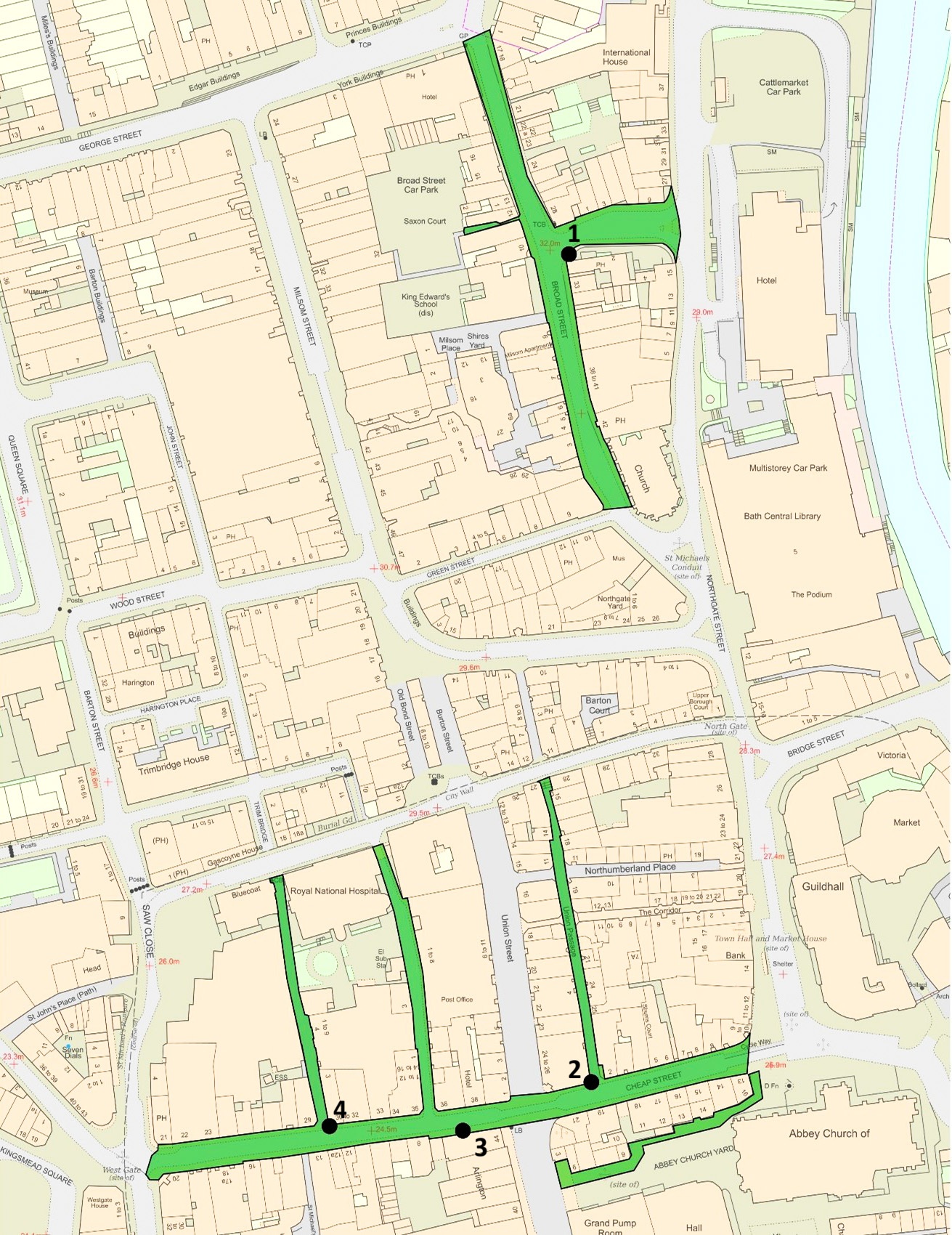
Bin 1: Broad Street, on the corner with Saracen Street, serving flats in Broad Street, Saracen Street, Saxon Court and Milsom Place
Bin 2: Cheap Street, on the corner with Union Passage, serving flats in Cheap Street, Union Passage and Abbey Church Yard
Bin 3: Westgate Street, opposite Parsonage Lane, serving flats in these two streets
Bin 4: Bridewell Lane, on the corner with Westgate Street, serving flats in these two streets
There will be weekly collections from these on-street food bins, and you can use them at any time.
What we can and can't accept
Make sure you only include the correct recyclable items in your food waste.
We accept all of the following:
- Uneaten food and plate scrapings
- Out of date food, including ready meals removed from packaging
- Bread
- Fruit skins and vegetable peelings
- Raw and cooked meat and fish and bones
- Dairy products (but not liquids)
- Egg shells
- Tea bags and coffee grounds
- Rice and pasta
- Beans
We don't collect any of the following items in your food waste:
- Food and drink packaging such as cups or boxes (even if it is biodegradable or compostable)
- Liquids
- Fat, or large quantities of oil
- Wooden cutlery or plates
- Flowers or garden waste (please use our Garden waste service for this)
Collection timetable
We collect your food waste every week. Find out when your next collection day is using our collection day finder.
Order a food waste container
Use our online service to order a 5-litre kitchen caddy or 23-litre food waste bin, or call Council Connect on 01225 394041
What happens to your food waste
Your food waste is taken to Codford Biogas in Wiltshire, where it is processed via anaerobic digestion to produce biogas, used for electricity generation, and nutrient-rich fertiliser, used on surrounding farmland. If every home in Bath and North East Somerset recycled its food waste, it would create enough electricity to power 1140 homes for a year. You can watch this video, produced in partnership with our previous food waste contractor GENeco, to find out more.