We aim to provide more travel choices for everyone. As set out in our Corporate Strategy, we want to make walking, wheeling, and cycling safer, more convenient and accessible. As well as providing better bus infrastructure to improve reliability and the bus journey experience.
We consulted on this project in summer 2023 and early 2025. View the consultation report.
Since then, we have carried out several studies to inform our proposals, including traffic modelling, safety risk assessments and parking analysis.
These improved travel choices will help to reduce congestion, connect rural areas to towns and cities, and improve air quality across Bath & North East Somerset.
The Somer Valley Links scheme will:
- make catching the bus by offering improved bus infrastructure and delivering safe, easy-to-use walking, wheeling and cycling facilities
- reduce bus journey times
- create or improve walking, wheeling and cycling routes which connect to communities along the corridor
- support opportunities for regeneration and economic growth along the corridor
- improve options for interchange between/with sustainable transport modes, at new travel hubs along the corridor
- give people more choices for how to travel, enabling some to use their car less, and supporting improved public health, as well as better air quality and cutting carbon emissions along the corridor
This will be done by introducing:
- more than 5km of pavement improvements, such as widening them and making them continuous
- 8 new travel hubs, providing opportunities to switch between transport modes
- upgrades for 22 bus stops, such as real time information and new shelters
- 3km of new pavements to make walking safer
- more than a kilometre in new cycleways to allow segregated cycling
- 25 new pedestrian crossings and with improvements to many more pedestrian crossings to make walking safer
- around 3km of new shared use paths for walking and cycling
- nearly a kilometre of new bus lanes to reduce journey times
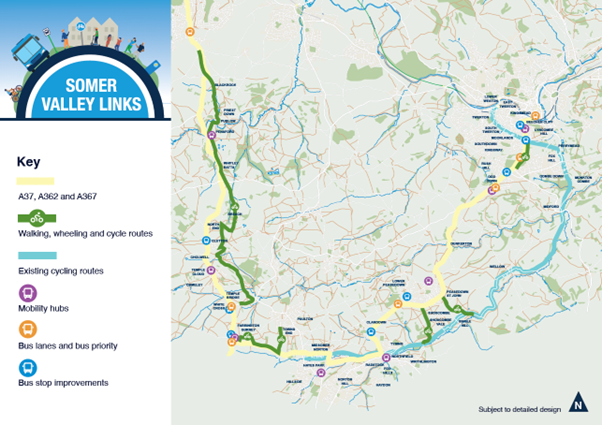
Map of Somer Valley Links project
Why we are doing this
The Strategic Outline Case and the Outline Business Case, both produced by West of England Mayoral Combined Authority, highlighted the existing challenges for sustainable travel in the Somer Valley. These include:
- heavy reliance on cars along the A37 & A367 with both routes often heavily congested
- bus journey times are too long because buses get stuck in traffic
- access to bus stops is hampered by narrow or non-existent pavements
- lack of safe pavements and crossing points
- cycling along the A37/A367 can be challenging even for confident cyclists due to high traffic volumes, including large vehicles passing close and travelling at high speeds
- there is little infrastructure linking cycling and bus services together making changing between the two difficult
- sections of the A37 through Pensford and Temple Cloud are not wide enough for large vehicles to pass each other, leading to delays for all traffic
- Farrington Gurney and Temple Cloud have air quality issues (declared Air Quality Management Areas (AQMAs))
- Collisions occur on the fast sections and junctions on the corridors