Please enable JavaScript in your browser to use this page.

You are here

  1. Home
  2. Schools, colleges and learning
  3. Inclusion and SEND Advice Service
  4. B&NES SEND Commitment - Ordinarily Available Provision

B&NES SEND Commitment - Ordinarily Available Provision

The B&NES SEND Commitment describes what can be reasonably provided for all children and young people, including those with SEND, from the resources ordinarily available in Early Years, Schools and Further Education Settings. It aims to provide a common understanding and increase trust and transparency about the adjustments that can be made to support a child with SEND. 

The document was created in consultation with parent/carers, children/young people and professionals across a range of educational settings.

Download the guide as a PDF.

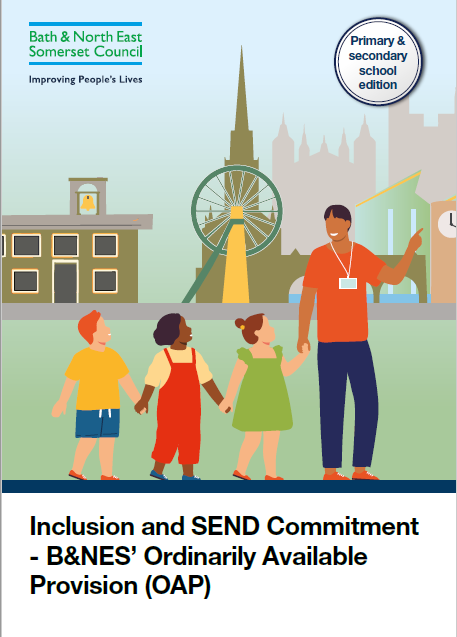
Preview of the SEND Commitment guide

Expectations of all settings

This section outlines the expectations of all education settings according to the needs of the child or young person. Many of the expectations and strategies will be an integral part of the education setting’s provision for all children.

The following headings outline some of the practices and adaptations that are fundamental to Quality First Teaching. The provision and strategies outlined in this section for children and young people with SEND and will often be of benefit to many of the learners in the setting.

Leadership and Management 

Expectations of all settings

  • All educational settings, from Early Years, Schools and Further Education providers must have arrangements in place to support children and young people with SEND.
  • The provision for children/young people with SEND, those with additional needs and disadvantaged groups is well led and managed.
  • Leaders are ambitious for children and young people with additional needs and this ambition is shared by staff.

Strategies

  • Governing bodies/trusts and setting leaders ensure that all staff are supported through annual professional development, advice and guidance to understand their role in supporting children and young people with SEND, additional needs and those from disadvantaged groups.
  • Staff are confident that the senior leadership team, including governing bodies/ trusts and support staff, are knowledgeable about inclusion of all children and young people, and that this is reflected in the school vision, values, practice, and school improvement plan.
  • The setting has a nominated Special Educational Needs Co-ordinator (SENCO), who is either part of the setting’s leadership team, or is consulted by the senior leadership team (SLT) liaises regularly with it.
  • Childminders are encouraged to identify a person to act as a SENCO and childminders who are registered with a childminder agency or who are part of a network may wish to share the role between them.
  • Effective monitoring of SEND provision to ensure SEND is the responsibility of all staff. Governing bodies trusts and setting leaders advise all parents/carers of children and young people with SEND to offer feedback on the SEND provision.
  • Reasonable adjustments will be made to setting policies to take account of the needs of children and young people with SEND. 

Assessment 

Expectations of all settings

  • A regular cycle of Assess, Plan, Do, Review (graduated approach) is used to ensure that children/young people with SEND are making progress.
  • Staff ensure that assessment (formal and informal) and feedback are a feature of lessons and evident in marking and assessment policy.
  • Expertise is in place to manage reasonable examination arrangements (access arrangements) for tests, national tests and public examinations. (Schools & Colleges) 

Strategies

  • Children/young people’s strengths and difficulties are observed and monitored in different settings and contexts to inform planning.
  • Staff make careful use of assessment to inform planning and interventions, ensuring meaningful baseline assessment is completed.
  • A wide range of assessment strategies and tools are used to ensure a thorough understanding of learners, for example in Early Years this would be the Early Years Foundation Stage Profile (EYFSP).
  • Settings should include parent and (where appropriate) pupil feedback on the Children/young people’s learning strengths and difficulties
  • Children/young people have regular opportunities to evaluate their own performance. Accessible self-assessment is routinely used to set individual targets.
  • The impact of interventions is critically evaluated. Alternative approaches are explored to establish whether they may result in better outcomes for the children/ young people.
  • Settings make adaptions to assessment arrangements as part of their everyday practice. This is used to establish the learner's normal way of working.
  • For older learners please refer to the relevant exam board guidelines. Arrangements could include:
    • Rest Breaks
    • Use of a reader/Scribe/laptop
    • Extra time
  • Early Years settings should consider when a request for Inclusion Support Funding (ISF) may be needed to ensure children can fully access their Early Years Entitlement (EYE) with appropriate additional support in place. Guidance and criteria on ISF can be located on the B&NES Livewell web pages.

Partnership with Children and young people, parents and carers 

Expectations of all settings

  • The setting works in partnership with parents, carers and children/young people in decision making.
  • An effective partnership with children and young people and parents is evident through their participation in assessment and review processes (B&NES Graduated Approach)

Strategies

  • Parents/carers are signposted to the SEND information relevant to the setting, such as the SEND Information Report on the school’s website.
  • Parents and carers are signposted to B&NES Local Offer.
  • Parents are clear about methods of communication with the setting such as use of a home school diary/book bag/text/email.
  • Parents are aware of SEND status of their child and the support and individually tailored interventions in place, using the B&NES Graduated Approach.
  • They are involved in setting and reviewing targets for their child.
  • Formal and informal events take place to seek views in relation to SEND provision in the setting e.g. children/young people and parent surveys, coffee mornings.
  • Children/young people are helped to understand how they learn best as well as their barriers to learning and to value their achievements.
  • Children/young people understand and are able to contribute to the targets they are working to achieve, appropriate to their developmental level.

Supporting Social, Emotional Development and Pastoral Care 

Expectations of all settings

  • The setting recognises, and responds to, the need for pastoral support for learners with SEND, bearing in mind the individual’s social and emotional needs and other relevant contextual circumstances.
  • Children/young people feel safe and valued. They know that they can approach staff and that their opinions and concerns are valued.
  • In Early Years Settings (Early Years Foundation Stage: 3.27) The key person helps the child to feel known, understood, cared about, and safe.

Strategies

  • Positive relationships are seen as paramount.
  • There is a calm and purposeful climate for learning where children/young people feel they belong, and their contributions are valued.
  • Children/young people can identify an agreed safe space (appropriate to the setting) and a named adult(s)/key worker(s) as a stable point of reference when required.
  • Language used across the setting demonstrates that children/young people are respected and valued.
  • Awareness that children/young people with SEND are vulnerable to bullying and an appropriate level of support and monitoring is in place.
  • Where age-appropriate, the whole setting seeks to engage with national initiatives that raise awareness of SEND such as Autism Awareness Day, Neurodiversity Day, World Mental Health Day etc.
  • Where settings deliver PSHE, it is used to develop wellbeing and resilience.
  • Children/young people’s awareness and sensitivity towards difference (including SEND) are raised at a whole setting level. Work is done with classes and groups regarding specific needs or conditions as appropriate.
  • Negative attitudes, beliefs and perceptions towards individuals and groups are challenged, in the setting and wider society. Child/young person’s voice is encouraged and acted on.
  • In very exceptional circumstances, where it is in the child/young person’s best interests, a plan to support attendance at school well may involve the use of a temporary, part-time timetable to meet individual needs.

Physical and Sensory Environment 

Expectations of all settings

  • The physical environment is adapted to meet the needs of children/young people
  • Staff are aware of sensory needs and issues that may impact on children/young people

Strategies

  • The physical accessibility of the building and individual learning spaces is assessed. The accessibility plan is on the setting’s website and “Reasonable adjustments” are made according to individual needs.
  • Reasonable adjustments should be made to ensure that children/young people’s personal care needs are met within the early years setting/school/college environment.
  • Where a child/young person has identified medical needs, staff are trained by the appropriate professional around the specific health need and any medication required.
  • The furniture is the appropriate size/ height for the children/young people.
  • Extra-curricular activities and educational visits are planned to fully include children/young people with SEND (in line with the Equality Act 2010), including those with SEMH and physical disabilities. “Reasonable adjustments” are made.
  • Children/young people’s views are routinely sought and are used to inform planning for physical or sensory adaptations that they may require.
  • Children/young people’s sensory needs are known and used to plan seating arrangements and movement breaks.
  • If sensory and/or physical needs are a barrier to wearing some/all of the school uniform reasonable adjustments are made.
  • Left and right-handed children/young people are able to use equipment comfortably.
  • Children/young people who wear glasses and/or hearing aids are encouraged to wear them and are seated in the optimum position.
  • Displays are meaningful and visually accessible to reduce sensory overload.
  • Staff are aware of lighting in the room e.g. use of natural light, glare from the board, who is facing the light, where you stand in relation to the light.
  • Use of pale background and accessible font styles on the whiteboard.
  • Staff are aware of smells and noise in the room and any particular individuals who may be impacted by these e.g. Classes next to the canteen or music room.
  • The effect of the environment will always be taken into account when addressing unexpected behaviour from a child/young person with SEND.
  • Settings are aware of how/where to access support around the sensory environment (e.g. a sensory audit) where required.

Staff Skills and Training 

Expectations of all settings

  • All adults in the setting work collaboratively to ensure maximum impact on the learning and progress of children/young people.
  • There is a plan for on-going Continuing Professional Development (CPD) in relation to the needs of the learners.
  • Staff collaborate and have effective links with other relevant outside agencies and specialists.

Strategies

  • Early Years settings – we are encouraging all BANES Early Years settings/providers and childminders to complete the free modules available as part of the Dingley’s Promise Early Years Inclusion Training Programme, to develop staff skills and encourage confidence in supporting children with SEND – to register/sign up to access the online training modules please visit Dingley's early years inclusion programme.
  • Additional adults are deployed proactively in the setting and their impact on the learner is monitored carefully to ensure progress is supported.
  • Grouping/seating arrangements and additional support are used to promote independent learning as far as possible.
  • Strategies used in interventions are integrated into class teaching so that learners can sustain progress.
  • There is a planned programme of ongoing CPD in relation to SEND for the whole setting and individual teams and departments.
  • Best practice is shared with a commitment to the B&NES CPD Strategy.
  • Practitioners know when to refer for extra support or advice e.g. The B&NES Advice Service.
  • The setting is aware of and regularly communicates with any other professionals who are involved with each learner.
  • Advice received from other professionals is used to inform teaching and learning.

Teaching and Learning Strategies 

Expectations of all settings

  • Staff are aware of the additional needs of their children/young people, understand the nature and impact of these and how to respond to them.
  • Planning incorporates more detailed specialist advice.
  • Staff provide suitable learning challenges and cater for different learning needs using adaptive teaching.
  • Staff ensure that children/young people have opportunities to work in different ways e.g. independently, in a variety of small groups and/or in pairs.

Strategies

  • Individualised and/or small group sessions.
  • Children/young people are given time to process information before being asked to respond.
  • Tasks are broken down into small manageable steps. These steps are shown explicitly.
  • The pace and order of activities is varied to maintain interest and attention of all children/young people.
  • Modelling is used to aid understanding. Visual/audio demonstrations and visual cues/audio commentary are used.
  • Staff ensure key vocab is understood and supported by visuals.
  • Alternatives to written recording are used routinely.
  • Study skills are explicitly taught where appropriate.
  • Schools ensure that children/young people have access to homework clubs, or additional support with homework. Homework is accessible for all children/young people.
  • Strategies are used to actively promote independent learning e.g. through pre-teaching, overlearning, appropriately differentiated resources.
  • Use of additional adults is planned to maximise their impact on learning.
  • In line with best practice in adaptive teaching, the curriculum and timetable should be adapted according to need.
  • Schools should consider providing children/young people with remote education on a case-by-case basis, such as where attendance has been affected by a special educational need or disability (SEND) or a mental health issue. This should be part of a plan to reintegrate back to school.

Equipment and resources 

Expectations of all settings

  • Resources are allocated appropriately to ensure additional needs are met. Quality and impact of support, is monitored.

Strategies

  • Resources are within easy reach of children/young people to promote independence.
  • Children/young people have easy access to the right equipment that they require, such as writing slopes, pencil grips, wobble cushions, fidget toys, ear defenders, and weighted blankets.
  • Resources are clear and uncluttered, labelled using text and images. Print size and font is appropriate. Coloured backgrounds and paper are used to reduce visual stress.
  • Where specialist equipment has been recommended and provided (e.g. specialist mobility aids, seating and/or standing equipment), staff should be trained to use the equipment and support the child/young person across the learning environment.
  • Adapted physical resources such as PE and Maths equipment are adapted to promote independence.
  • Technology is used to support alternatives to written recording and to promote independent learning where appropriate to need.

Transition and Transfer 

Expectations of all settings

  • Support is in place for routine and life transitions when required.
  • Transitions are planned for well in advance to ensuring smooth progression through settings, particularly during all transition phases.

Strategies

  • Information is actively sought and shared about the child/young person to support successful transitions and manage change both within the setting and beyond.
  • Early Years settings should consider how best to ensure a smooth transition to school, e.g. consider if an application for Transition Support Funding (TSF) is needed. Guidance and criteria on TSF can be located on the B&NES Livewell webpages.
  • This information is available for the learner’s parents and carers, other colleagues within the setting and receiving or previous settings as required.
  • Staff are aware of children/young people who need additional support while transitions and adjustments are made, e.g. additional visits to a new setting/classroom with a familiar trusted adult, creating social stories.
  • How well children/young people with SEND are prepared for their next step in education, employment and training.

Within settings, transitions include:

  • Moving around the setting
  • Preparing for weekends and the start of holidays and beginning of term
  • Moving from lesson to lesson/room to room
  • Changing from structured to unstructured times
  • Moving from break to lesson times
  • Moving from one activity to the next within a lesson
  • Changes of staff - permanent and temporary
  • Special events: visitors, visits, celebrations
  • Life events: birth of a sibling, change in parenting arrangements e.g. change in parents relationship status, loss and bereavement or contact visits
  • Puberty

Staff are aware of those who will need additional support for all or most transitions and plan for these transitions. This includes learners who:

  • Have insecure attachment
  • Have social communication difficulty
  • Suffered trauma, loss or bereavement
  • Are anxious

Link to Glossary