Use this page to find out more about School Streets and our commitment to creating safer, healthier and calmer environments outside schools.

What are School Streets?
School Streets use timed vehicle restrictions to create safer, healthier calmer spaces outside schools at the start and end of the school day. They can apply to a whole street, part of a street or several roads.
The restrictions typically operate during weekdays in term-time, and last 30 to 60 minutes. During these times, essential vehicle access is maintained for those that need it via automatic or permit exemptions
Additional street improvement and traffic calming measures might also be considered and, along with the timed vehicle restrictions, children and families are actively encouraged by the school to walk, wheel or cycle their journey.
Benefits
- A calmer start and end to the school day
- More children travelling actively
- Safer routes for walking, cycling and wheeling
- Better physical health and mental focus for children
- Fewer vehicles entering the neighbourhood during the school run
- Cleaner air and reduced road noise
Our approach
We are working in partnership with schools to develop School Streets and these schemes are only introduced where there is a willingness from the school, there is a clear need within the community, and the timed restrictions are feasible.
All schools in B&NES are welcome to apply, but to be shortlisted, schools must meet specific criteria and be enrolled in the Modeshift STARS programme. This is a national accreditation scheme which recognises excellence in promoting sustainable travel.
Encouraging active travel is an integral part of the School Streets programme and helps reduce the number of vehicles entering the area, rather than simply moving traffic onto surrounding streets.
Each School Street is designed in collaboration with the school and local community, following a period of engagement and formal consultation.
We provide training and support for schools to launch and maintain the School Streets, and we will monitor their effectiveness in terms of reducing traffic, uptake of active travel among children and families, and air quality where this is a consideration.
Our School Streets
Four flagship School Streets were identified for development in 2025/2026.
Please expand the sections below to find out more about proposals for each School Street.
Following a public consultation held in February 2026, we launched a School Street outside St Stephen’s Primary Church School. It launched on Monday 18 May during national ‘Walk to School’ week.
Permit applications are now open for those requiring essential vehicle access.
Following a public consultation in February 2026, we launched a School Street outside Widcombe Infants and Junior School on Monday 22 June.
Following a public consultation in spring 2026, we launched a School Street outside St Philips Church of England Primary School on Monday 6 July.
Permit applications are now open for people requiring essential vehicle access.
The School Street outside Newbridge Primary School was progressed under a separate programme and launched on Monday 8 June.
Permit applications are now open for people requiring essential vehicle access.
About timed restrictions
School Streets restrict vehicle access for 30 to 60 minutes at the beginning and end of each school day. Essential access is maintained for those who need it. The exact times are agreed with the school and local community but typically run from 8:15–9:15am and 2:50–3:50pm.
Residents with vehicles registered to an address on the School Street will be provided with an exemption permit on request as set out below under Exemption permits.
Enforcement of the scheme is tailored for each school and location. We typically enforce the scheme in the following way:
- No motor vehicle signage, such as 'Pedestrian and Cycle Zone' signs, would be installed at the entrance(s) to the designated street, streets or section of street, depending on the design. These signs show the times of the restrictions, and some can be folded or covered up during holidays and weekends.
- Temporary barriers, provided by the council, are stored at the school and used on the street to enforce the scheme. These barriers can be easily moved and set up by stewards.
- Under agreement with the school, enforcement is facilitated by stewards from the school - or community volunteers - who will allow access for vehicles with an automatic or permit exemption. See the 'Exemptions' section below.
Full training is provided to volunteer and school stewards before launch.
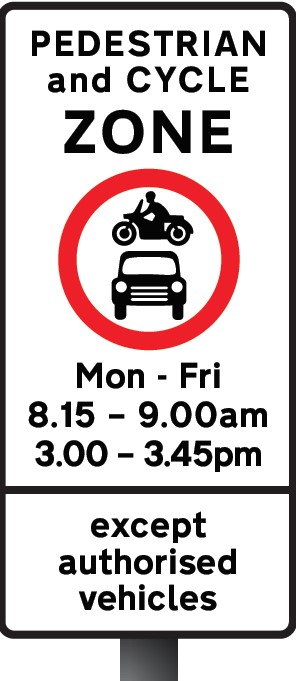
Illustration of a Pedestrian and Cycle Zone sign typically used at the entrance of School Streets promoting the timed restrictions
Exemptions
During School Street operating hours, vehicle access is restricted to help create a safer environment for children. However, some vehicles are allowed access if it's essential and this is agreed in the traffic regulation order for each School Street.
Please expand the sections below for more details.
These vehicles can access School Streets during operating hours without a permit:
- Emergency services (e.g. police, fire, ambulance)
- Blue Badge holders
We may also allow automatic access for the following, depending on the specific design of the School Street:
- Postal and some delivery services (e.g. Royal Mail)
- Utility companies (e.g. gas, electricity, telecoms)
- Local authority vehicles (e.g. waste collection)
- Environment Agency and water/sewerage services
We would also consider issuing permits for essential access, tailored to each School Street and available on application for:
- Residents with vehicles registered to an address on the School Street
- Parents or carers of children with an Education, Health and Care Plan (EHCP)*
- Families with children or carers who have a temporary disability*
- School transport vehicles (e.g. minibuses)*
- Medical and social care workers who require vehicle access during operating hours
*The issuing of permits to school transport vehicles and to parents or carers of children with EHCPs, or to those with a temporary disability or medical concern, would be at the discretion of the school and ourself (as the local authority).
View the full terms and conditions for exemption permits before applying.
Exemptions are not usually granted to:
- Parents or carers without an EHCP or disability exemption
- School staff
- Employees of local businesses
- Residents living near but not on the School Street
- Delivery drivers in private (non-company) vehicles
- Residents who do not live on the School Street
Steps to installing a school street
We will follow these steps to develop a School Street, working with the school, local community and key stakeholders.
All schools in B&NES can express an interest in becoming a school street and they are selected based on feasibility of the road network, the school’s progress towards Modeshift STARS accreditations, and the willingness of the school to facilitate it.
We assess the street layout, traffic patterns, and surrounding impacts to determine viability and we collect baseline traffic data on the school street and surrounding streets where required.
Early engagement with the school, school community and residents helps to understand local needs and promote the aims and benefits of School Streets.
A Memorandum of Understanding is signed with the school, outlining roles, responsibilities and expectations for implementing and maintaining a School Street. The school gathers data on how the children travel to school, and the council develops a tailored design, considering signage, enforcement, exemptions, and access needs. Proposals are prepared for consultation.
Early engagement with residents and the school community informs the final design and the content of the Traffic Regulation Order (TRO) which is subject to a statutory 21-day public consultation.
A decision to proceed is made based on feedback from the statutory consultation, as well as council policy.
Before launch, we open the exemption process, issue permits, and provide training for school staff and volunteers. The scheme is then installed, including signage and any street improvements and traffic calming measures included in the plan.
Once installed, we monitor traffic and travel behaviour to assess the School Street’s effectiveness, drawing on baseline counts. We may also monitor air quality where required. Adjustments are made as needed.
Contact us
For more information on School Streets, please email school_streets@bathnes.gov.uk, or call 01225 394 025 and request a callback.
If you would like to express your interest in a School Street, start by engaging with your local ward councillor, asking them whether they would support a proposal.
Once you have gained support from the ward councillor, email details to Traffic_ManagementTeam@bathnes.gov.uk. We will log requests and review them when we are in a position to progress new School Streets.
Funding and policy
The Council has approved funding to deliver three School Streets, and one will progress under a separate programme and funding.
School Streets contribute to meeting the aims of our Journey to Net Zero commitments, our Corporate Strategy to improve lives and improve travel choices, and our Vision Zero strategy to eliminate all traffic fatalities and severe injuries while increasing safe, healthy, and fair access to street space.
In June 2024, a recommendation from the Climate Emergency and Sustainability Policy Development and Scrutiny Panel was that all schools in Bath and North East Somerset should be able to express an interest in becoming a School Street and each was invited to apply. Three of 18 applications were shortlisted to become School Streets.
For more information, read the Single Member Decisions on School Streets or read our press release.