This page features information on the B&NES Food Strategy 2026 to 2031.
If you are struggling to afford or access food, BANES Food Finder highlights food clubs and pantries available in Bath and North East Somerset. These are provided by organisations offering affordable food or emergency food parcels. Some of these require you to meet certain qualifying criteria.
Visit the Food Finder website here.
If you are in need of support or advice, please contact the Community Wellbeing Hub B&NES.
Live Well B&NES also have a Cost of living information and advice page on their website.
Food in Bath & North East Somerset
Food is part of who we are in B&NES. It shapes our landscape, our local economy and the way our communities come together.
From the farms and orchards of the Chew Valley and Somer Valley to the independent cafés, bakeries and producers that give Bath its character, food runs through daily life. We're fortunate to have a strong community of growers and food businesses, dedicated volunteers and food charities, and a proud history of doing things differently - including being home to the UK's first farmers' market.
Our Food Strategy
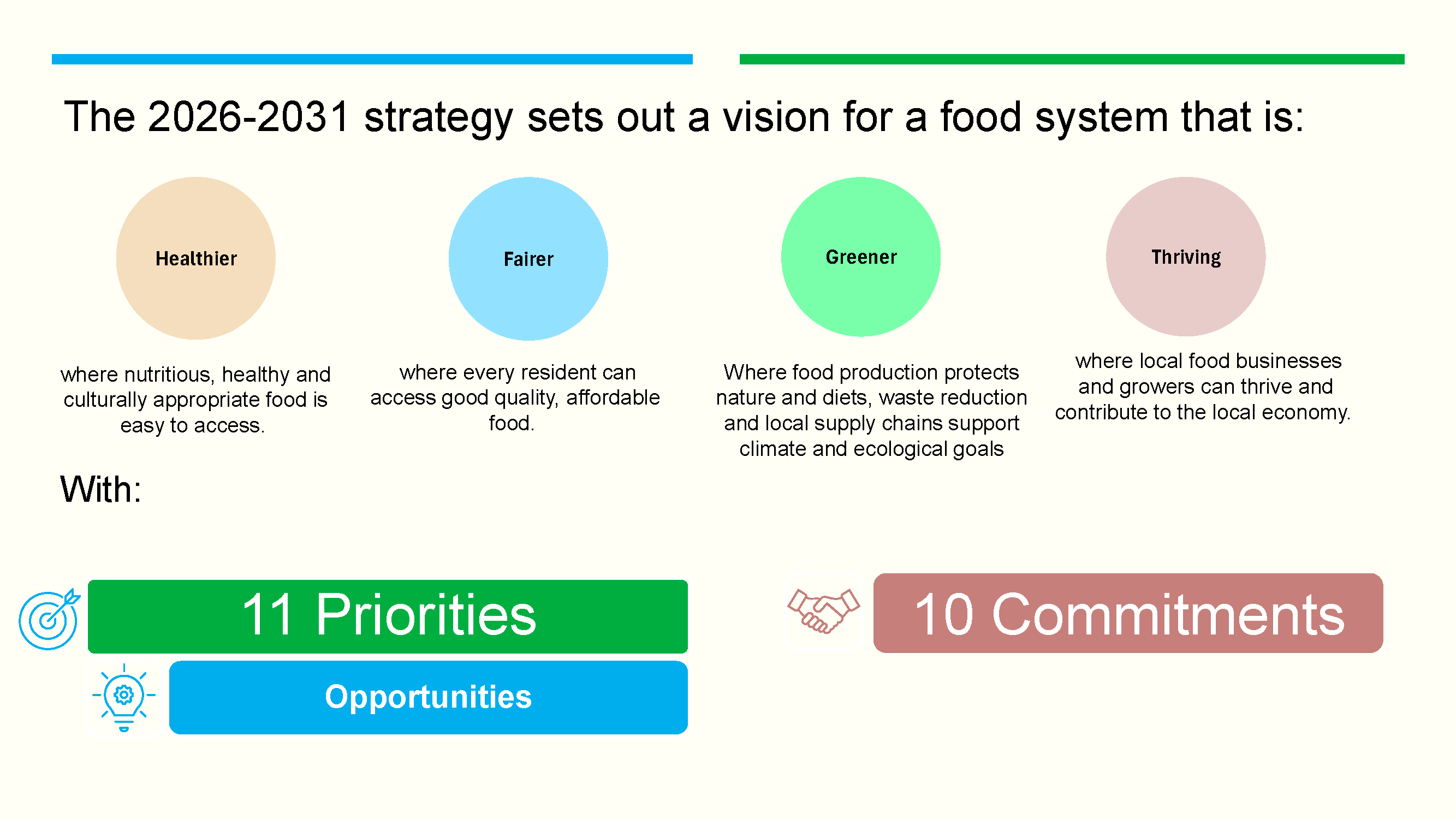
Our 2026 to 2031 Food Strategy builds on a decade of local action and celebrates the people, projects and local food assets we already have, and sets a clear shared vision for the next five years.
It also sets out the key needs and gaps that must be addressed to make the local food system healthier, fairer and greener, whilst supporting the conditions for local food growers and businesses to thrive.
The strategy has been developed through extensive collaboration: Engagement with residents, community groups, the voluntary sector, food businesses, farmers, and public services has provided a detailed and nuanced picture of local strengths and the challenges that still need to be addressed.
This has been combined with national policy, local data and examples of best practice from other areas.
Click to expand
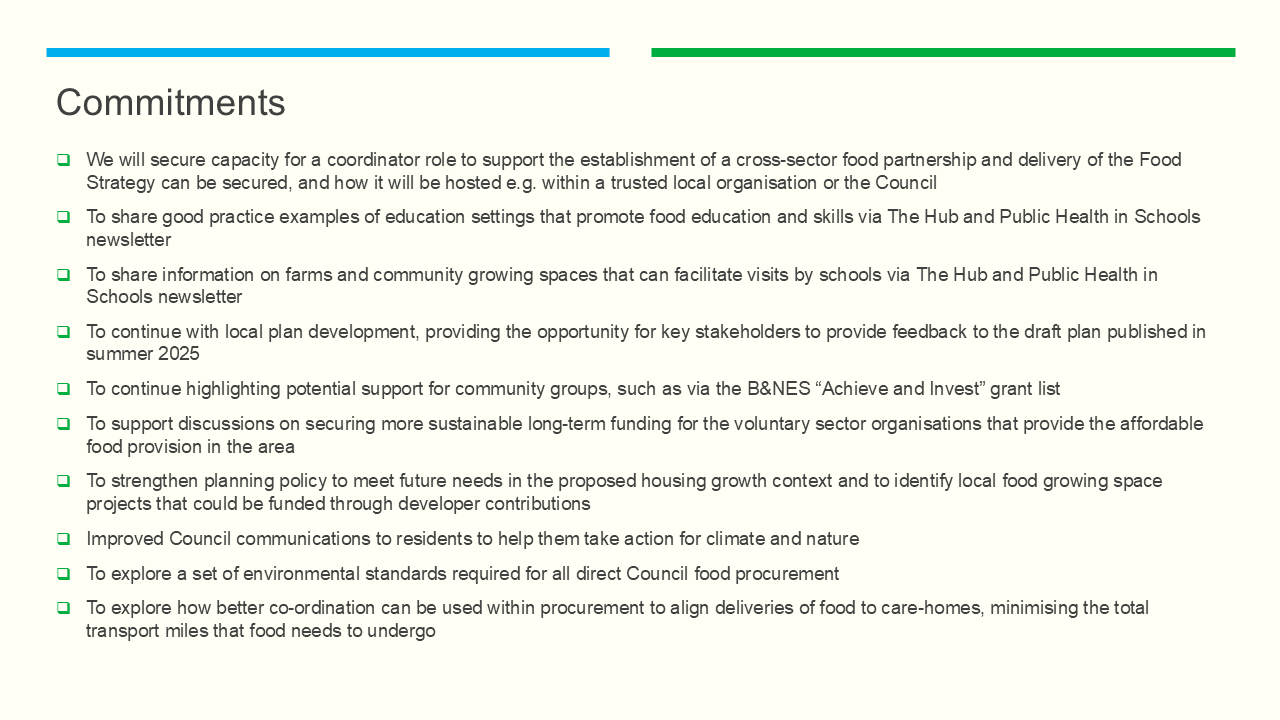
To achieve these objectives, the strategy sets out priorities that we, our partners and communities wish to deliver. For some priorities, we are in a position to commit to taking action immediately.
Click to expand
For others, as they require us and our partners to identify and mobilise capacity and resources together, they are expressed as opportunities and are outlined in the full strategy document.
The final draft, which was presented to the Health and Wellbeing Board is available to read here.
To support delivery of the Strategy, a Partnerships and Policy Manager is funded (short-term) by the Climate and Environment team to facilitate delivery of the Strategy, and including establishing a new Food Partnership with key partners. Further funding will be needed to continue this work.
Working in partnership
No single organisation can transform a food system alone. This strategy sets a shared direction for joint action, enabling B&NES to build a food system that benefits people, place and the environment.
We will do this through the creation of a food partnership.
The structure and members involved in the partnership are currently being worked on and we will update this page with more information when it’s ready.
If you have any questions relating to the food strategy and our approach, you can email food_strategy@bathnes.gov.uk
Good Food Local Benchmarking
In 2026, the South West was the latest region to participate in Good Food Local - a national benchmarking platform to help local authorities drive change.
You can view Bath & North East Somerset’s results here.
Fair Food Alliance
St John’s Foundation Trust funds a Public Health Officer who leads the B&NES Food Equity Action Plan and coordinates the Affordable Food Network, through which we support initiatives to redistribute surplus food in B&NES, such as Cropdrop and Fareshare South West.
We are also working with Fareshare to input into plans for a landmark new food and essentials distribution hub in the West of England, to maximise the benefits for food provision in Bath and North East Somerset.